


Despite all the achievements of science and progress, the fungus as a disease cannot be eliminated.This is due to their ability to survive and living conditions.The fungus needs moisture and heat.As long as they exist, the fungus will exist.
Types of nail fungus
dermatophytes
They affect the body due to decreased immunity.In extremely rare cases - in a person with a high level of immunity.
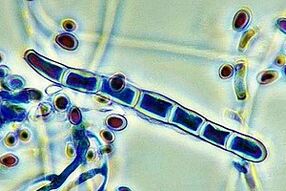
The source of infection is the soil, sometimes people or animals.The basis of the entire colony is the mycelium.It is attached to the nail by processes (hyphae), which grow into the tissue and destroy the structure.
Subspecies of dermatophytes and features of the course of the disease:
- Trichophyton red.The disease progresses according to the standard: the tip of the nail becomes infected, and then progresses to the root.The fungus tends to affect several fingers at the same time.The nail changes shape, thickening and becoming rough.Delamination is observed.The skin around the affected nail also becomes infected: it dries and peels;
- Trichophyton interdigitalis.The source of the disease is rooms with high levels of humidity.Most often it affects the nails of the big toes.Located on the surface of the nail and the skin between the fingers.Whitish spots form on the plates;
- Other types of dermatophytes affect the body against the background of other diseases in 5% of all cases.
Yeasts of the genus Candida.
In fact, they are present in human skin and mucous membranes.It is not necessary to meet a carrier of the disease.It is enough to have a weakened immune system for fungi to occupy the nail plate.
The peculiarity of the course of the disease is that the nail is affected not at the end, but at the base, growing in the direction of growth, since Candida does not form mycelium and cannot adhere to the surface at the edge.
mold
The causative agents of onychomycosis are more than 40 species.It is difficult to diagnose the damage caused by this type of fungus;The symptoms do not differ much from the symptoms of damage caused by dermatophytes.
However, the treatment is fundamentally different.The diagnosis of mold infection can only be made through bacteriological analysis.
The subspecies is capable of releasing hyphae and quickly destroying the nail.In addition, in conditions of a critical decrease in the patient's immunity, mold fungi can penetrate the body and infect organs.
There are 2 additional classifications.
Classification according to the origin of the disease:
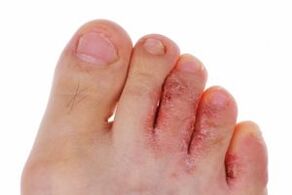
- vesicular fungi.The bottom of the foot is mainly affected.Blisters and swellings appear on the skin.This type of fungus is easily associated with a bacterial infection;
- membrane Located in the area between the little finger and the "ring" toe: the skin cracks and peels off in large flakes.It may be accompanied by a bacterial infection;
- mocasinopods.The disease is located on the heel or sole of the foot and gradually spreads upward.
Classification according to the form of deformation of the nail layer:
- normotrophic.The nail changes color, but retains its shape.Stripes and/or spots of yellow and white tones appear;
- hypertrophic.The structure and shape of the nail is deformed: the nail becomes thick, begins to crumble and causes pain during movement;
- atrophic.The nail “loses weight.”The plaque becomes very thin, opaque, and white spots and streaks appear.
Toenail fungus: signs of infection
Main visible and tangible symptoms:
- itchy skin, especially after swimming;
- the appearance of an unpleasant odor;
- peeling of the skin;
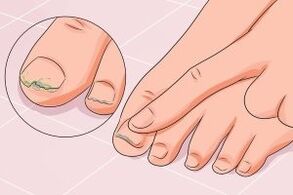
- the nail has changed color.As a rule, the entire nail plate acquires a uniform shade.The color depends on the subspecies of the mushroom, but most often it is yellow;
- the nail plate becomes rough;
- separation along the tip of the nail.It occupies the entire open length of the nail and gradually deepens;
- white spots under the nail plate;
- the boring;
- many burrs;
- detachment of the entire nail;
- large-scale destruction of the nail;
- small notches along the entire outer surface of the plate;
- the nail plate thickens and the lower layers crumble.
Is it possible to completely cure toenail fungus?It is possible, but not always.A hereditary disease that cannot be changed is a living example of this.It progresses over the years, deforming the shape of the nail.
The fact of a hereditary disease can only be confirmed by a medical consultation.
How to effectively cure toenail fungus: drug treatment
To select medications, it is necessary to accurately diagnose the type of fungus, the stage of the disease and the type of skin.Only a doctor can do this.
Depending on the test results and the stage of the disease, the doctor will prescribe local medications (ointments or varnishes) or a complex of local and systemic medications.
Systemic medications suppress the pathogen, preventing reproduction.Topical medications have an effect on the application area, destroying the fungi.
Systemic medications place a large load on the liver.You will have to abandon everything that complicates the work of the organ: alcohol, fatty foods.This is necessary to avoid double loading.
There are special means to remove nails without surgery.
Each drug acts only on a certain type of mycosis.Even the most advanced remedies will not work if they are not "combined" with a fungus.
How to cure toenail fungus: home remedies
Vinegar is the most effective method in the initial stages.
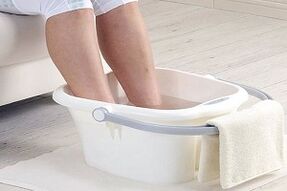
Baths: a glass of table vinegar (9%) per water bath.As a rule, a basin is used, in which the feet are placed.The water pours up to the ankles.Firstly, this ensures the proper concentration of vinegar in the water.
Second, the skin is exposed to a chemical burn.Before bathing, it is necessary to cut your nails and remove the top layers of skin with a pumice stone or brush.This will ensure maximum "impregnation".
If there are microdamages to the legs, the procedure will cause pain.Duration – 15 minutes.
Vinegar Lotions: Soak a cotton ball in vinegar and apply it to the problem area for 10 to 15 minutes. It is more effective to use it after bathing.
Ointment: 2 parts acetic acid (70%) mixed with glycerin, olive oil and dimethyl phthalate, one part each.Apply with a cotton swab for 8 hours every day on clean feet.Wash with laundry soap.
To combat the advanced stage, hydrogen peroxide is used.The feet are steamed in a soda bath (1 teaspoon per 1 liter), then cotton wool soaked in peroxide is applied to problem areas, covered with polyethylene and wrapped with a bandage.The duration of the compress is 40 to 60 minutes.
Ammonia.For a glass of water - 1 tablespoon.l.alcohol Soak a cotton ball or a piece of gauze and apply it overnight as a compress.
Boric acid.Before going to bed, they steam their feet, sprinkle them with talcum powder and put on clean socks.
Baking soda.Add a little water until a paste forms and apply the mixture to the problem area for 15 to 20 minutes.
Garlic.Rub the affected area with a cut clove of garlic.Vegetable pulp can be used as a compress.
Iodine.Just lubricate the problem area well.
How to quickly cure toenail fungus
Complex treatment will be required, consisting of systemic antifungal drugs and local agents.Medications are prescribed by a doctor.
It is recommended to combine traditional medicine and medications.
Features of the treatment of neglected fungus
First of all, diagnosis and consultation with a doctor.

Complex treatment will be required, which means:
- take broad-spectrum medications orally;
- narrow focus directly on the nail;
- strengthen the immune system;
- taking medications that support the body while taking essential medications;
- Strictly follow the instructions.
Medicine is designed in such a way that when treating a disease, a blow is dealt to a healthy organ.Most often: the liver and intestines.You should be prepared for the consequences and discuss the side effects of medications with your doctor in advance.Some cause allergies or are unacceptable for certain diseases during pregnancy.
If the stage is critical and nothing helps, the last option remains: complete removal of the nail plate, but this does not always guarantee relief from the disease.
What is the danger of untreated onychomycosis?
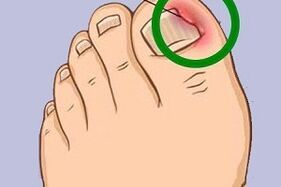
The disease can progress to a stage when most of the available remedies stop acting on the fungi: the spores will penetrate deep into the tissues and the drugs simply will not be able to reach them.
Deformation of the shape of the plate causes deep ingrowth of the skin of the nail, even cutting the tissue.
The result is hellish pain and inflammation in the tissues of the toes.Both the nail and the tissue surrounding it will begin to rot.
An advanced stage of deformation of the nail plate makes it impossible to wear shoes.Any shoe that even slightly squeezes your toes will cause severe pain.Even just walking around the house barefoot can hurt.
Besides:
- general decrease in immunity;
- fungal spread to the blood;
- the appearance of dermatitis and eczema;
- Inflammation of the mucous membranes.
Prevention
Antifungal prophylaxis is based on the following factors:
- personal hygiene.It is necessary to wash your feet daily with soap.Cut your nails in a timely manner, do not pull off hangnails, and use only personal pedicure tools.If you have to bring strangers, sterilize them.Wear clean socks.Do not wear used shoes;
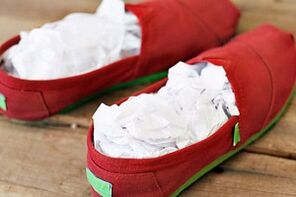
- shoe care.Shoes must be dried in a timely manner, thereby preventing the formation of favorable conditions for fungal growth.Take out the insoles and dry them separately, dry the shoes with special dryers or untie them completely and place them under the radiator;
- Of course, not visiting baths and saunas is not an option.Give preference to those establishments that have reviews.If possible, ask what and how often the floors are washed.Be sure to only use your own things and especially replaceable rubber slippers;
- To avoid reinfection, throw away any shoes the patient wore during the illness.If this is not possible, sterilize it inside;
- If your immune system is weakened or you have microdamage to your feet, try not to walk barefoot and avoid situations where the fungus could infect you.